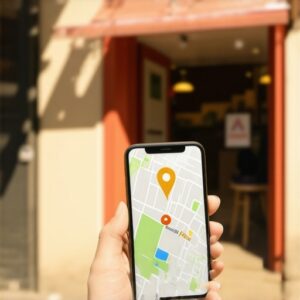
The smell of wet concrete and the metallic ozone of a passing subway train defines my mornings. I spend my days walking the grid, capturing the cracks in storefronts and the glitches in the digital map. I see things others miss. I see the sign that says Open when the Map Pack says Permanently Closed. I see the plumber who claims to have an office in a luxury high-rise but really operates out of a dented white van parked three blocks away. This is the reality of the local search layer. It is a fragile world held together by GPS coordinates and the hope that Google does not look too closely. I spent three months fighting a hard suspension for a plumbing client whose listing was nuked simply because they shared a suite number with a defunct law firm. Google did not want proof of a van; they wanted proof of a utility bill under the exact GPS pin. They wanted a video walk-through of the door, the lobby, and the tools in the back room. The client was terrified of losing five years of hard-earned feedback. We had to move slowly. We had to prove the business existed without breaking the thread that held their reputation together. This is how you fix the address verification nightmare without watching your business vanish.
The ghost in the GPS coordinates
Address verification issues often arise when Google detects a mismatch between the GPS pin and the official registry. To fix this without losing Google Business Profile reviews, you must provide primary documentation like utility bills or tax records that mirror the formatted address exactly. When you move a pin, you are not just moving a dot on a map. You are moving a beacon in a spatial database. If that beacon flickers, Google assumes it is a ghost. I have seen businesses fall into a manual action on your google business listing simply by clicking the wrong button in the dashboard. The system is sensitive. It looks for signal noise. If your suite number is shared with a business that was banned three years ago, you inherit their ghost. This is why verified business addresses still fail to rank in high-density zones. The algorithm sees the shared wall and suspects a lead-gen farm. To break the loop, you need a unique footprint. Stop using virtual offices. Stop using PO boxes. The AI knows the difference between a desk and a mailbox. It sees the 1,200 other businesses registered to that same latitude and longitude. Use the gmb audit checklist that actually moves the needle to verify your own data before the algorithm does it for you. Precision is the only way to survive a re-verification request.
Why your physical address is a liability
A physical address becomes a liability if it is flagged for proximity spam or shared with other service area businesses. Maintaining visibility requires unique office space that lacks duplicate listings or high signal noise from previous tenants who were suspended or penalized for spam. I have watched storefronts die because the previous tenant ran a locksmith scam. The digital scent of failure lingers on the coordinates. When you try to verify a new business at an old, toxic address, the system triggers an automatic flag. This is when people start looking for steps to take when your business profile disappears from maps without warning. It is not always what you did; it is what happened there before you arrived. You must scrub the history. You need to look at the ghost of old addresses that might be tethered to your brand. Google keeps a ledger of every pin that ever existed. If you do not decouple your brand from the previous failure, you will never rank. This requires a professional approach to how to fix the duplicate listing error once and for all. You cannot just delete the old pin and hope for the best. You have to claim it, close it, and then build your new authority on clean ground. It is like developing property; you have to remove the old foundation before you pour the new one.
Local Authority Reading List
- The Blueprint for Top Google Map Pack Placement
- Leveraging Pro Map Services
- Mastering GMB Optimization in 2025
- Advanced Local SEO Tactics
- Expert Tips to Dominate GMB
The three mile radius that determines your revenue
The vicinity algorithm restricts your reach based on a three-mile radius from the verified centroid. Expanding this map pack presence requires high interaction metrics and localized citation consistency across major directories to prove to the local search engine that your business is relevant. I walk the streets and see how the map changes every block. At 1st and Main, the pizza place is number one. At 4th and Main, it is gone. This is the proximity shift. If you try to verify an address that is too far from your actual service area, you are fighting physics. You cannot win. You must understand why your local map reach stops at the city border. It is not a bug; it is a feature. The algorithm wants the user to have the shortest travel time possible. If your address is verified in a residential zone but you service the downtown core, your interaction data will look suspicious. People will see your listing, see the distance, and click away. This lack of engagement tells Google you are not the right fit. Use 7 tools to verify your gmb keywords to see where your actual rank boundaries lie. If you move your address to gain a better centroid, you must do it with a strategy that protects your reviews. Check out moved your office 5 steps to stop your rank from tanking. Do not just change the field in GMB. Update your website, your social media, and your niche citations first. Build the digital bridge before you walk across it.
“Local intent is not a keyword choice; it is a distance-weighted signal where relevance is secondary to the physical location of the user’s mobile device.” – Map Search Fundamental
The microscopic math of review migration
Review migration occurs during a rebrand or address change if the business profile is moved correctly rather than replaced. To prevent losing trust signals, you must use SEO services that specialize in consolidating profiles and managing the GMB reputation management toolkit. Reviews are the currency of the street. If you lose them, you are broke. Most people think they can just create a new listing when verification fails. That is a death sentence. You lose the years of behavioral data that told Google you were trustworthy. You must follow the pro guide to consolidating multiple gmb profiles. If you have a duplicate listing, do not delete it yet. Merge it. The math of review sentiment is complex. Google tracks the velocity of your reviews and the location of the people writing them. If you suddenly change your address and your review count stays the same but the location of the reviewers doesn’t match the new radius, flags go up. This is why your review count stayed the same while your ranking dropped. You must maintain the connection. Use services to restore trust signals for local seo to ensure the transition is smooth. Reviews are not just stars; they are geo-tagged evidence. If you move from Brooklyn to Queens, your Brooklyn reviews still have weight, but you need fresh Queens-based interaction to anchor the new location.
Why business category shifts trigger the filter
Changing your primary category can trigger a manual review or a partial suspension. Recovering GMB visibility after a category change requires aligning your website content with the new classification and using local SEO tools to verify that your metadata matches the new focus. I have seen it happen a hundred times. A business thinks they will rank better if they change from General Contractor to Home Builder. They hit save. Ten minutes later, the listing is under review. The algorithm sees the change and asks for new verification. Suddenly, your reviews are in limbo. This is where the simple change to your primary category becomes a complex technical hurdle. You need to look at finding the right gmb category to outrank rivals without triggering the spam filter. The key is to update your site’s schema first. If your website says one thing and your GMB says another, the trust score drops. Use the simple fix for conflicting business category data to sync your ecosystem. If you are hit with a seo services to fix partial suspension, do not panic. It is usually a data mismatch. Provide the proof that you actually offer the services in that new category. Take photos of your equipment. Take photos of your staff in branded gear. The AI loves images. It can read the text on your van in a photo and use it as a verification signal.
The forensic trace of a service area polygon
Service area polygons tell the algorithm where your workers operate. If these areas are too broad, Google may shadowban the profile. Using a GMB ranking tool for agencies helps identify where your location signals are weak or where duplicate pins are interfering. For a service area business, the address is often hidden. This does not mean the address does not matter. Google still needs a verified home base. If that home base is a residential house, you are under a microscope. I once helped a client who was invisible in the very town where he lived. We looked at the data and found the specific signal gaps making your business invisible. He had set his service area to cover the entire state. Google does not believe a one-man shop can cover 500 miles. It looks for the signal density fix. By shrinking the polygon to a realistic twenty-mile radius, his ranking actually went up. He became more relevant because he was less suspicious. If you are struggling with how to recover from a shadowban, look at your service area settings. Are they greedy? Are they realistic? The map is about proximity, not just reach. Use tracking your local map reach to see where the signal drops off. If it drops at the city line, you have a data consistency problem.
Restoring trust through visual evidence
Visual evidence such as exterior storefront photos and customer-uploaded images creates a trust signal that AI overviews prioritize. High-traffic map listings thrive on interaction data where users engage with authentic imagery rather than stock photos or low-quality marketing materials. I hate stock photos. They are the lies of the digital street. Google’s Vision AI can detect a stock photo in milliseconds. It provides zero trust. If you want to fix a verification issue, you need to show the truth. Take a photo of your office door with your sign on it. Take a photo of the street sign at the corner. This is the strategic way to use photos for better map pack placement. Every photo you upload has metadata. It has GPS coordinates baked into the file. When you upload a photo from your office, you are telling Google, I am here. This is why interaction metrics matter. When customers upload photos of your business, they are providing third-party verification. That is more powerful than any postcard. If you are dealing with why google doesn’t trust your business anymore, start by cleaning up your images. Delete the stock trash. Upload grainy, real, honest photos of your daily work. That is what the photographer sees. That is what the algorithm wants to see. It is the forensic proof of existence. Also, ensure you are managing reputation by encouraging customers to take photos when they visit.
The tactical checklist for profile recovery
Profile recovery after a Google quality penalty involves a GMB audit checklist. You must fix NAP inconsistencies, remove toxic citations, and ensure your domain change or website redesign didn’t break the technical link between your site and the map listing. Most businesses panic when they see a suspension. They start changing everything at once. This is a mistake. You need to follow the suspension survival kit. First, check your citations. Use practical fixes for nap inconsistencies. If your phone number is different on Yelp than it is on your GMB, that is a red flag. If you recently changed your website, you might have broken links on your website killing your local authority. The Google bot crawls your site to verify the info on your profile. If it hits a 404 on your contact page, it loses trust. Check how we found and fixed 404 errors to see the impact. You also need to look at your backlink profile. If you bought cheap links, you are in trouble. See why cheap backlinks are tanking your local map authority. The algorithm is smarter now. It wants quality, not quantity. It wants local relevance. A link from the local Chamber of Commerce is worth more than a thousand links from a Russian link farm. This is how to rebuild trust after a local ranking drop. It is slow work, but it is the only work that lasts.
Managing the aftermath of a verification loop
A verification loop occurs when the system fails to accept new address data. Resolving this involves syncing business data across directories and using a suspension survival kit to provide forensic proof of your business location without triggering a permanent ban. If you are stuck in a loop, it is usually because there is a piece of data out there that contradicts your claim. Maybe an old Facebook page has your old address. Maybe an old listing on a forgotten directory is still active. This is why why automated citation tools often make your local seo worse. They create messy, duplicate data that the algorithm cannot reconcile. You have to do the manual work. Use the checklist for fixing incorrect nap data. Clean up the mess. If you are moving, follow why your new address triggered a ranking drop to see how to reverse it. It is about signaling. You have to broadcast the same message from every corner of the internet. When Google sees the same address on your site, your GMB, your social media, and your utility bills, the loop breaks. The system finally says, Okay, I believe you. Then, and only then, do you get your map pack spot back. To finish, remember that the map is a reflection of the physical world. If your digital presence is messy, the algorithm assumes your business is too. Keep it clean, keep it real, and keep the reviews you worked so hard to get. Use restoring trust signals to get back to the top and stay there. The street never lies, and neither does the data.