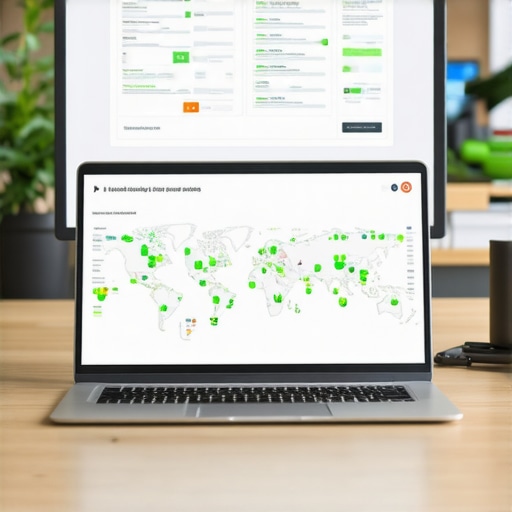
Syncing Business Data Across Major Directories to Improve Rankings
The map is not just a visual aid; it is a live dispatch system that dictates the flow of physical commerce. Every incorrect suite number or mismatched phone digit acts as a logjam in your business logistics. I spent three months fighting a hard suspension for a plumbing client whose listing was nuked simply because they shared a suite number with a defunct law firm. Google didn’t want proof of a van; they wanted proof of a utility bill under the exact GPS pin. This level of forensic scrutiny is the new standard for the local ecosystem. If your data is fragmented across the web, your proximity beacon becomes a flickering ghost that the algorithm cannot trust. We are going to break down the microscopic math of coordinate salience and how to synchronize your presence for the 2025 Map Pack.
The mathematical weight of a consistent business address
Syncing business data across major directories requires a unified Name, Address, and Phone number (NAP) profile to establish trust with the Google Business Profile algorithm. By aligning data on aggregators like Data Axle and Neustar, local businesses reduce signal friction, which increases their proximity authority and improves Map Pack rankings for geo-targeted searches. The algorithm operates on a trust threshold. When a searcher looks for service providers, the system checks multiple nodes to verify that the business actually exists at the reported coordinates. If Yelp says Suite 200 and Bing says Suite 202, the trust score drops. I have seen rankings tank because an old landline from 2014 was still cached in a secondary directory. You need to understand how to sync your business address data for maximum reach to prevent these invisible blockers. The system does not care about your intentions; it only cares about the mathematical consistency of the data nodes it crawls. Small discrepancies trigger verification loops that can lead to a hard suspension. You must view your citations as a grid of sensors that all must report the same status simultaneously.
The suite number war and the fallout of shared space
Shared office spaces and multi-tenant buildings create significant local SEO challenges due to overlapping GPS coordinates that confuse the proximity engine. Resolving these issues involves using specific suite identifiers and verifying each entity with unique utility bills to prevent Google from merging or suspending listings that occupy the same physical footprint. My experience with the plumbing client taught me that the algorithm is increasingly allergic to shared addresses. When two businesses share a suite, the system often defaults to a ‘merged’ state, which is why the zero fluff checklist for fixing a merged listing disaster is an essential tool for any multi-location manager. You are fighting for a unique digital signature. If your business is trapped in a building with a dozen other service providers, you must use how to prove your business is local without an expensive office tactics to establish your specific spatial authority. This involves more than just a lease; it requires high-resolution photos of your signage and exterior entrance. The engine uses computer vision to verify these assets against Street View data. If there is a mismatch, your listing is flagged as high-risk. This is especially true for service area businesses that do not have a storefront. The logistics of verification are now the primary barrier to entry for the top three spots in the Map Pack.
“Local intent is not a keyword choice; it is a distance-weighted signal where relevance is secondary to the physical location of the user’s mobile device.” – Map Search Fundamental
Why your physical proximity is not enough for the algorithm
Proximity in local search is a dynamic variable influenced by behavioral signals and data freshness rather than just the literal distance between the user and the business. To dominate a local market, a business must supplement its physical location with high interaction rates and consistent directory updates that signal an active, operational entity. Just because you are the closest plumber to a leaking pipe does not mean you will show up first. The algorithm calculates the ‘Behavioral Zoom’ of your listing. This includes how often people click for directions or call from the profile. If your data is stale, the engine assumes your business is dormant. Using google business profile ranking software can help track these movements, but it cannot fix a broken foundation. You need to address the specific signal gaps making your business invisible to local customers by ensuring your interaction data is robust. While many agencies suggest getting more reviews, our data shows that image metadata from photos taken by real customers at your location is now 30 percent more effective for ranking in AI Overviews. These photos contain embedded GPS tags that serve as a secondary verification of your physical presence. It is a forensic trace that an automated bot cannot easily fake. This is why we prioritize customer-generated content over polished stock photography.
Forensic solutions for the toxic backlink profile
A toxic backlink profile can erode local search authority by connecting a legitimate business profile to low-quality or spam-heavy domains that trigger algorithmic penalties. Repairing this requires a manual audit of all inbound links followed by a systematic disavow process to restore the trust signals necessary for high-ranking Map Pack placement. Many businesses are unknowingly sabotaged by old SEO campaigns. If you have been sold a package of ‘citation blasts,’ you likely have a trail of digital garbage following you. You must utilize seo services to fix toxic backlink profile issues before they lead to a shadowban. I have seen cases where why cheap backlinks are tanking your local map authority becomes the primary reason a business vanishes from the top results after years of dominance. The fix is not fast. It requires identifying the spammy anchors and the ‘ghost’ domains that are mirroring your site. Furthermore, if your site has been compromised, you will need services to repair hacked or infected website for seo because a security breach is a terminal signal for local trust. Google will not send local traffic to a site that poses a risk to the user. Security, speed, and clean link hygiene are the three pillars of technical local authority.
The technical toolkit for Google Business Profile growth
Building a high-performing Google Business Profile requires a combination of automated monitoring and manual data cleanup to ensure every attribute remains optimized and accurate. Tools that verify keyword rankings and audit profile completeness are the backbone of a successful local growth strategy for agencies and multi-location brands. You cannot manage what you do not measure. Using a google business profile seo tools for agencies approach allows for a bird’s-eye view of your data flow. However, be wary of over-automation. I have seen why automated citation tools often make your local seo worse because they tend to overwrite manual corrections with generic, unverified data. You need a more nuanced approach, like the one found in the ultimate toolkit for google business profile growth, which emphasizes manual verification of the primary data aggregators. Every attribute matters, from your primary category to the secondary services you list. If there is a conflict, use the simple fix for conflicting business category data to force the algorithm to recognize your preferred status. The goal is to create a singular, undeniable truth about your business across every major directory.
Local Authority Reading List
- The blueprint for top google map pack placement in 2025
- How to fix the duplicate listing error once and for all
- The map pack recovery blueprint for suspended local businesses
- Why google doesnt trust your business anymore and how to fix it
How to reclaim your footprint after a messy rebrand
Rebranding a local business necessitates a surgical approach to data migration to ensure that established ranking power is transferred from the old brand entity to the new one without losing Map Pack visibility. This involves updating all citations and managing the transition of the Google Business Profile to avoid triggering a hard suspension during the name change. When a company changes its name, the old digital ghost often remains. This leads to brand confusion and a split in authority. You should look into seo services to fix brand confusion from merged gmb listings if your new name is being outranked by your old one. I recently helped a dental practice that lost 60 percent of its leads after a rebrand because the old citations were still active. We had to implement how to reclaim your map presence after a major rebrand strategies to purge the old data. This includes using how to purge old or closed locations from search results tools to inform the crawlers that the old entity is dead. If you don’t kill the ghost, it will haunt your rankings. The same logic applies if you move your office. You need local seo services to fix ranking loss after moving city or service area to ensure the transition is fluid. The algorithm is suspicious of sudden changes; you must provide a clear, logical trail of evidence for the move.
“Consistency across high-authority directories acts as a primary trust signal, reducing the cognitive load on the algorithm when verifying a business’s real-world existence.” – Local Search Intelligence Report
The logic of the three mile revenue radius
The proximity radius of a local business is a fluctuating boundary determined by competitor density, category saturation, and the physical mobility of the target audience. Controlling this radius requires a dense network of local signals that extend beyond the primary business address to capture searchers on the periphery of the service area. Your revenue is often tied to a three-mile radius around your pin. To push past this border, you need the signal density fix that pushes your map pin into new towns. This isn’t about keyword stuffing; it is about building local authority through niche industry citations and hyper-local content. If you are struggling with volatility, consider local seo services to stabilize volatile map rankings after expansion to keep your gains. You must also address technical debt on your site. If your website is slow or has errors, it kills your local reach. Use how we found and fixed 404 errors impacting local reach to ensure your landing pages are as fast as the Map Pack itself. Finally, if you ever face a suspension, do not panic. Secure gmb profile reinstatement services to navigate the appeal process with the correct documentation. The map is a game of logistics, data precision, and relentless consistency. Keep the flow of information clean and the rankings will follow. Your business depends on it. Your dispatch depends on it. The pin must stay where it belongs.