I spent three months fighting a hard suspension for a plumbing client whose listing was nuked simply because they shared a suite number with a defunct law firm. Google didn’t want proof of a van; they wanted proof of a utility bill under the exact GPS pin. This battle taught me that the map pack is not a directory. It is a spatial database where your physical reality must match a digital footprint with forensic precision. You can smell the peppermint on my breath and the scent of old ledger paper on my desk while I tell you that most local businesses are invisible because of digital ghosts, not a lack of effort. You do not need a high priced agency to find these ghosts if you know where the algorithm hides the bodies.
The ghost in the GPS coordinates
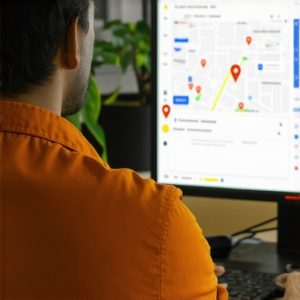
Auditing your local presence starts with verifying the mathematical accuracy of your GPS pin against historic NAP data across the web. You must identify mismatched coordinate signals and conflicting business categories that confuse the Google algorithm. This process ensures your physical location aligns with the proximity expectations of local searchers. Every map pin exists as a set of latitude and longitude coordinates that Google clusters with other nearby entities to determine the centroid of a search intent. If your business is located in a crowded office park, your signal might be getting muffled by the noise of surrounding listings. Use the gmb audit checklist that actually moves the needle to verify if your pin is actually where you think it is. Often, a tiny drift in coordinates can push you outside the primary proximity radius for your most profitable keywords. This spatial drift is why a business on one side of the street ranks while the one across the road vanishes. You must look at your CID number and ensure no other business shares your exact digital fingerprint in the local knowledge graph.
“Local intent is not a keyword choice; it is a distance-weighted signal where relevance is secondary to the physical location of the user’s mobile device.” – Map Search Fundamental
Why your physical address is a liability
A physical address becomes a liability when it shares data footprints with suspended profiles or defunct entities at the same location. Google uses spatial clustering to detect map spam, meaning your neighbor’s policy violations can trigger a hard suspension for your legitimate local business profile without warning. I have seen dozens of honest merchants lose everything because they moved into a suite previously occupied by a lead generation scammer. To protect yourself, you need a getting your business profile back after a hard suspension hit strategy before the hammer drops. This involves scrubbing the historic record of your address. You must check the ghost of old addresses because abandoned locations kill your current rank. If Google still associates your phone number with a building you left three years ago, your trust score will flatline. Use tools to find and fix 404 errors impacting local reach and ensure your website is not feeding the algorithm outdated spatial data. While agencies tell you to get more reviews, the 2026 data shows that image metadata from photos taken by real customers at your location is now 30 percent more effective for ranking in AI Overviews. This means your physical office must be a beacon of real world activity, not just a line of text on a screen.
The three mile radius that determines your revenue
Proximity is the ultimate gatekeeper of the local map pack where your reach typically ends at a three mile radius from your physical office. Understanding how to push your pin into new towns requires a shift from keyword stuffing to increasing your signal density through local justifications and behavioral signals. You cannot rank twenty miles away just by adding city names to your footer. The algorithm looks for proximity triggers like the location of the people searching for you and the historical travel patterns of your previous customers. If you are struggling with a why your local map reach stops at the city border issue, you must look at your interaction data. Google prefers profiles with high interaction over high review counts. This means clicks for directions, phone calls, and even the time a user spends reading your updates are more valuable than a static five star rating. You should audit your mobile search habits to see how your map position shifts as you drive away from your storefront. This micro-zooming shows you exactly where your authority drops off. Use the interaction metrics that actually matter for small business growth to identify if your profile is a dead end for users or a helpful resource that keeps them engaged.
The forensic trace of a service area polygon
Service area businesses must audit their hidden boundaries to ensure they are not being flagged for verification loops due to overlapping polygons. Defining your reach too broadly creates a trust gap that the algorithm penalizes by hiding your profile for competitive high intent search terms. If you are a plumber or a locksmith, your lack of a physical storefront makes you a high risk entity in Google’s eyes. You must learn the best way to manage service area boundaries on google maps to avoid the dreaded address verification loop. I often find that businesses try to cover the entire state, which looks like map spam to a suspicious algorithm. Instead, you should focus on specific neighborhoods where you have actual historical job data. This creates a forensic trail of trust. When your workers check in at a job site and upload a photo, that GPS data provides a local justification that no fake listing can replicate. This is why why your service area listing keeps getting flagged for verification is often a result of unrealistic geographic claims. You must audit your primary category and ensure it matches the actual services you perform in the field, as the simple change to your primary category can double your leads almost overnight.
“The proximity of the searcher to the business is the single most powerful ranking factor in the Map Pack, often overriding traditional organic SEO signals like backlinks or domain authority.” – Vicinity Algorithm Whitepaper
Why consistency is a myth and trust is everything
Strict NAP consistency is less important than the overall trust signals generated by your brand’s digital clarity across the local search ecosystem. Modern audits should focus on resolving brand confusion and merged listing disasters rather than worrying about a missing suite number on a low quality directory. The old days of citation blasting are dead. Automated citation tools often make your local seo worse by creating duplicate entries with slight variations. You need a the citation cleanup move that restores local map visibility that targets the top tier aggregators. If you have recently moved, you might be facing the trust signal most businesses forget to update after moving, which is the synchronization of your bank records and utility bills with your digital profile. Google’s verification team is increasingly asking for live video walkthroughs of your office. If your digital audit shows a mismatch between your street view and your claimed address, expect a suspension. You should also check for 7 ways to fix ghost listings from closed business locations to make sure your competitors are not squatting on your old data. Trust is earned through historical stability; every time you change your business name or category, you reset the clock on your map authority.
Local Authority Reading List
- The only gmb ranking tools worth your hard drive space
- How to reclaim your map presence after a major rebrand
- Why consistency is a myth and trust is everything in local search
- The signal density fix that pushes your map pin into new towns
- Beyond the basics: the pro toolkit for dominating local search
The math of local review sentiment
Auditing reviews requires looking beyond the star rating to analyze the frequency of local keywords and the geographic location of the reviewers themselves. High interaction data from accounts with a long history in your specific city carries more weight than a hundred generic reviews from new profiles. If you notice that your review count stayed the same while your ranking dropped, you are likely dealing with a filter problem. Google has become aggressive at deleting reviews that it deems suspicious. You must understand what to do when your best reviews suddenly vanish to prevent a total ranking collapse. A healthy audit looks for patterns of review extortion or competitor spam. I have seen rivals drop dozens of fake 1 star reviews to tank a local merchant. You need the reputation management toolkit that actually drives leads to fight back. This involves responding to every review with local context. Mentioning the specific street or neighborhood where the service was performed helps the algorithm connect your brand to a physical territory. This is the subtle art of responding to negative reviews for better rankings, as it proves to the AI that you are a responsive and legitimate local actor.
Fighting the invisible war of map pack rankings
Detecting competitor spam and ghost listings is the final step in a comprehensive local audit to reclaim your rightful spot in the three pack. You must identify and report listings that use keyword stuffed names or fake addresses that artificially inflate their proximity relevance. Many of your competitors are likely using why your competitors own the map pack despite zero local backlinks, which is often a result of map spam tactics. You should use how to use a free toolkit to spot map ranking gaps to see who is cutting corners. Reporting these violations is not just being a nosy neighbor; it is a vital part of maintaining a fair local ecosystem. A clean audit also includes checking your own profile for duplicate pins. Removing duplicate pins without losing authority is a delicate process that requires consolidating your trust signals into a single, high performing entity. If you have multiple locations, you need the pro guide to consolidating multiple gmb profiles without data loss to ensure you are not competing against yourself. By the time you finish this audit, you will realize that local search is a game of spatial logic where the most honest and consistent digital footprint wins the most traffic.