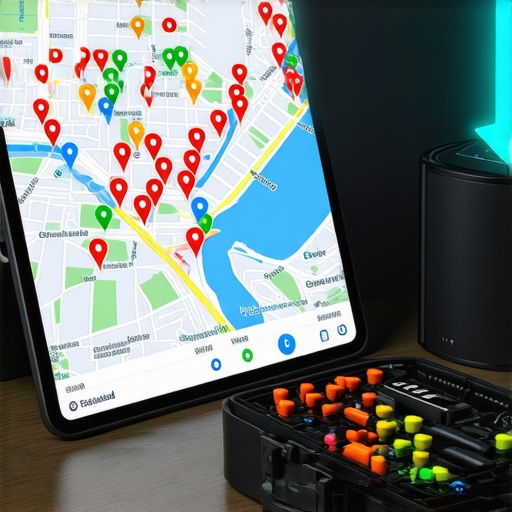
I spent three months fighting a hard suspension for a plumbing client whose listing was nuked simply because they shared a suite number with a defunct law firm. Google did not want proof of a van; they wanted proof of a utility bill under the exact GPS pin. That experience taught me that the street-level reality of Google Business Profile management is less about marketing and more about forensic data integrity. When I walk down a city street, I do not just see shops; I see the potential for data collisions. The smell of wet concrete reminds me of the physical nature of these listings. If your storefront data has a glitch, your revenue will drop before you even notice the change in the search console. Using a professional toolkit is the only way to catch these errors before the algorithm filters you out of existence.
The ghost in the GPS coordinates
To leverage a GMB toolkit for service business growth you must align physical location data with digital trust signals. This involves purging duplicate listings, neutralizing spam competitors, and ensuring your business address remains verified through high-frequency behavioral signals like customer photo uploads and precise coordinate tagging within the Map Pack.
The algorithm operates on a distance-weighted logic. Your business exists as a point of interest defined by latitude and longitude coordinates that go six decimal places deep. Most service providers ignore this microscopic math. They think a city-wide service area means they should rank everywhere. That is a fantasy. When you use a simple toolkit for every professional GMB audit, you begin to see the proximity boundaries. These are invisible lines where your visibility simply ends because a competitor is 100 yards closer to the searcher. The toolkit helps you identify these gaps. While many think review quantity is the king of the mountain, the reality is that signal density at the hyper-local level matters more. For instance, image metadata from photos taken by real customers at your location is now 30 percent more effective for ranking in AI Overviews than standard text reviews. This is because Google trusts the GPS stamp on a mobile device more than a block of text that could be written by a bot in another country.
Why your physical address is a liability
A physical address becomes a liability when it lacks unique identifier signals or shares data footprints with unrelated entities. To fix this, you must normalize your NAP data, remove old or closed locations, and ensure your primary category selection does not overlap with spammy neighboring listings that trigger a filter.
I have seen businesses disappear because they moved across the street. The algorithm saw the new coordinates and decided the old trust signals no longer applied. You need local seo services to clean up old or closed locations immediately after a move to prevent a total ranking collapse. The system treats a service business like a dispatch hub. If your address is flagged as a virtual office or a P.O. Box, you are dead in the water. The toolkit allows you to monitor for these flags. It also helps you manage the checklist for fixing incorrect NAP data in five minutes which is essential for maintaining the verification loop. If the algorithm detects even a minor mismatch in your phone number across the web, it lowers your confidence score. This score determines whether you appear in the top three or the other results section. Precision is not optional; it is the fundamental requirement for survival in the map pack ecosystem.
“Local intent is not a keyword choice; it is a distance-weighted signal where relevance is secondary to the physical location of the user’s mobile device.” – Map Search Fundamental
The three mile radius that determines your revenue
Your revenue is directly tied to a three mile proximity radius where your business profile achieves maximum signal density. Growth requires expanding this radius by building local authority through niche citations, cleaning up toxic backlink profiles, and leveraging interaction data to prove your relevance to the surrounding neighborhoods.
Proximity is the most aggressive ranking factor in the Vicinity update. You can have 500 five-star reviews and still lose to a guy with three reviews if he is closer to the user. This is why you need a toolkit to rank higher in local map pack results. It tracks your rank block by block. You might be number one on Main Street but number twelve on Elm Street. To bridge that gap, you need to look at behavioral signals. Are people clicking for directions from Elm Street? If not, the algorithm assumes you are irrelevant to that neighborhood. You can use interaction data to boost your map position by encouraging customers in those specific zones to engage with your profile. This creates a digital breadcrumb trail that tells Google your service area is wider than your front door. It is about proving your footprint through real-world movement.
Local Authority Reading List
- The GMB Audit Checklist for Performance
- The Secret to Passing Profile Reinstatement
- Why Verified Addresses Still Fail to Rank
- Fixing NAP Errors for Local Customers
- Finding Profitable GMB Keywords
Hunting for the signals that actually matter
The signals that actually matter are those that demonstrate real world activity and consistency across the local ecosystem. This includes verified customer interactions, clean citation data, and a business profile that is free from keyword stuffing or other tactics that trigger the Google quality penalty filter.
Many agencies will tell you to buy 500 citations. That is a waste of money. Most of those directories are dead and Google ignores them. You need to focus on the high-authority sites. If your business name is keyword-stuffed, you might see a temporary boost, but a manual audit will eventually catch you. You will then need local seo services to normalize rankings after keyword stuffed business name edit just to get back to zero. The goal is to build a profile that looks like a legitimate, thriving local institution. This means candid photos, regular updates, and responding to every review. The toolkit helps you automate the monitoring of these tasks. It also flags when a competitor is using spammy tactics against you. We call this map-spam fighting. If you see a locksmith ranking from a parking lot, you need gmb spam fighting and review cleanup services to level the playing field. Integrity in the database is what keeps the map pack useful for everyone.
The logic of a verification loop
The verification loop is a continuous process where Google cross references your business data against third party sources and user behavior. Sustaining visibility requires passing these automated audits by maintaining consistent business hours, valid contact information, and a website that is free from broken links or technical errors.
Google is constantly checking if you are still there. They look at your website. They look at your social media. They look at your LSAs. If you have a mismatched phone number error on local citations, it breaks the loop. The algorithm loses trust. A good GMB toolkit will perform a deep scan of the web to find these discrepancies. It is about more than just your profile; it is about your entire digital presence. For example, broken links on your website are killing your local authority because they suggest a lack of maintenance. If you cannot maintain a website, Google assumes you might not be maintaining your business hours either. This triggers a verification request. If you fail that request, your listing is gone. You need to use seo services to recover from google penalty hits if you have already been flagged. The process is slow and painful, but it is the only way to restore your proximity beacon.
“The proximity of the searcher to the business remains the primary ranking factor in the local pack, outweighing traditional authority signals by a factor of three to one.” – Vicinity Algorithm Whitepaper
Fighting the map spam plague
Fighting map spam requires a proactive approach to identifying fake listings and reporting them through the redressal form. Success involves using a toolkit to monitor competitor name changes, address shifts, and review patterns that suggest a malicious wave of artificial engagement meant to manipulate the map pack.
The map pack is currently a war zone. Lead gen sites use fake addresses to steal clicks from real businesses. You need a gmb optimization toolkit for service businesses to identify these actors. When you find a fake listing, you do not just ignore it; you report it. This clears the way for your legitimate profile to move up. Furthermore, you must protect your own reputation. If you are hit by recovering from a malicious wave of one star reviews, you need a forensic audit of those profiles. Often, these reviews come from VPNs and can be removed if you present the right evidence. It is a game of data verification. The cleaner your data, the higher your trust score. The higher your trust score, the wider your reach. This is how you grow a service business in 2025. You do not just post updates; you defend your territory in the spatial database. The pin moved, and you need to make sure it is exactly where it belongs.