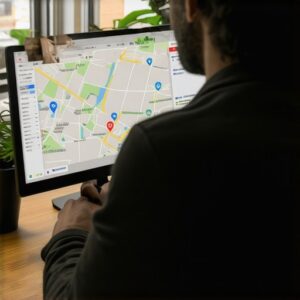
I walk these streets and see the world through a thirty five millimeter lens. I notice the wet concrete after a morning rain and the way a faded shop sign hangs at a slight angle. To most, these are just city details. To me, they are the physical manifestation of a data point. When the digital record does not match the grit on the ground, a glitch occurs. That glitch is what kills your ranking. Most business owners think of their address as a place where they receive mail. In the hyper local layer, your address is a set of coordinates in a spatial database. If those coordinates are even slightly off, you become a ghost.
The ghost in the GPS coordinates
Local NAP data auditing requires verifying your Name, Address, and Phone number across every digital directory to ensure search engines trust your physical location. Accuracy directly impacts your Map Pack visibility and determines whether Google Business Profile algorithms consider your business a legitimate entity or a spam risk.
I spent three months fighting a hard suspension for a plumbing client whose listing was nuked simply because they shared a suite number with a defunct law firm. Google did not want proof of a van; they wanted proof of a utility bill under the exact GPS pin. This is the reality of the modern map pack. You are not just fighting competitors; you are fighting a mathematical filter that hates ambiguity. If your suite number is missing on Yelp but present on Facebook, you are creating friction. That friction is why outdated business information is like poison for local SEO. The algorithm sees the conflict and decides it is safer to show a business with consistent, albeit boring, data.
Local Authority Reading List:
- – https://professionalmappackoptimization.com/the-gmb-audit-checklist-that-actually-moves-the-needle
- – https://professionalmappackoptimization.com/why-outdated-business-information-is-like-poison-for-local-seo
- – https://professionalmappackoptimization.com/why-consistent-contact-data-is-more-important-than-backlinks
- – https://professionalmappackoptimization.com/the-simple-toolkit-we-use-for-every-professional-gmb-audit
- – https://professionalmappackoptimization.com/cleaning-up-the-messy-contact-data-that-confuses-google-search
The three mile radius that determines your revenue
Proximity signals operate on a distance weighted logic where the physical distance between the searcher and the business often outweighs traditional authority metrics. If your NAP data is inconsistent across the web, your proximity radius shrinks because the search engine lacks confidence in your precise location data points.
This is where most agencies fail. They sell you a thousand citations on sites no one visits. I call these citation blasts for dead directories. They are useless. You need to focus on the high ground. Start with a manual search of your phone number. You might find an old version of your business from five years ago. This is a common culprit. If you have moved, why your local map presence depends on accurate address data becomes painfully clear. Google keeps a historic record of every business that ever occupied your space. If the previous tenant was a pizza shop and you are a law firm, and the data is not cleaned, the map engine gets confused. It starts associating your coordinates with the wrong category.
“Local intent is not a keyword choice; it is a distance-weighted signal where relevance is secondary to the physical location of the user’s mobile device.” – Map Search Fundamental
To fix this, you must look at the microscopic math of coordinate salience. When you enter your address into Google Business Profile, it generates a CID (Cluster ID). This ID is the anchor for all your reviews, photos, and history. If you have duplicate listings that are stealing your authority, you are splitting your ranking power between two different CIDs. It is like trying to fill two buckets with one hose. Neither ever gets full. You need to identify the primary record and merge the rest. This is a surgical process, not a sledgehammer one.
Why your physical address is a liability
A physical address becomes a liability when it is used for multiple business profiles or linked to residential properties in violation of service area guidelines. Search engines use forensic tracing of utility bills and official registrations to verify that a business actually operates at the location it claims.
I once investigated a case where a roofing company vanished from the Map Pack overnight. I found the problem in their Local Services Ads. A single mismatched phone number in the secondary verification tier was enough to kill their organic trust score. They had used a tracking number on a landing page but forgot to link it to the main profile. This created a NAP conflict that looked like lead generation spam. We had to implement cleaning up the messy contact data that confuses google search protocols to restore the link between their physical office and their digital identity.
The audit process starts with a free spreadsheet. List your official name, your exact address as it appears on your lease, and your primary local phone number. Do not use tracking numbers for your primary NAP. Use them for ads, but keep the core profile clean. Use a tool like the simple toolkit we use for every professional GMB audit to scan the major aggregators. You are looking for the big three: Data Axle, Neustar, and Foursquare. If the data is wrong there, it will keep trickling down to the smaller sites like a slow leak in a basement.
The forensic trace of a service area polygon
Service area businesses must define their reach using specific polygons or zip codes rather than a single point on a map to avoid suspension. The algorithm analyzes the behavioral patterns of your staff and customer interactions to verify if you actually serve the areas you have claimed.
If you are a service area business, hiding your address is a common move. However, seo services to recover impressions after hiding business address are often necessary because Google tends to favor businesses with a visible, verified storefront. The physics of a 3-mile proximity radius shift means that as you move away from your verified center, your visibility drops. This is why why your map presence disappears exactly two miles from your office. The solution is not more keywords. The solution is signal density. You need check ins, customer photos, and reviews from the specific towns you want to target. This creates a geographic relevance that the algorithm can calculate.
Take a look at your website footer. Is the NAP there an exact match for your GMB? I mean every period and every comma. If your site says Street and your GMB says St, it might seem small, but to a machine, it is a mismatch. Use the schema tweak that forces your map pin into more searches by adding LocalBusiness JSON-LD to your contact page. This tells the AI precisely where you are in a language it speaks fluently. It includes your latitude and longitude, which is the ultimate way to resolve NAP ambiguity.
The logic of a check in signal
Mobile devices tracking user movements provide the most powerful verification for local businesses through passive check in signals. When the algorithm sees customers spending time at your physical location, it validates your NAP data far more effectively than any third party directory could.
This is the behavioral zooming I talk about. We move from the math of the address to the behavior of the human. If twenty people with GPS enabled phones walk into your shop every day, Google knows your address is real. If you are a fake listing in a virtual office, no one ever goes there. The lack of behavioral signals is a red flag. This is why why google flags real addresses as fake and how to fix it often involves proving human traffic. Encourage customers to take photos while they are at your business. The metadata in those photos contains a GPS stamp. When that stamp matches your NAP, your trust score hits the roof.
If you have been hit by a penalty, do not panic. Use a recovery guide for businesses hit by the google quality penalty to systematically clean your profile. Check for is a hacked website killing your google maps position because a compromised site can inject bad meta data into your local listing. This happens more than people think. A simple audit is about finding the truth and making sure the internet reflects it. It does not take a fortune. It takes a camera, a spreadsheet, and the patience to look at the details that everyone else ignores. You need to be the person who notices the glitch in the concrete.